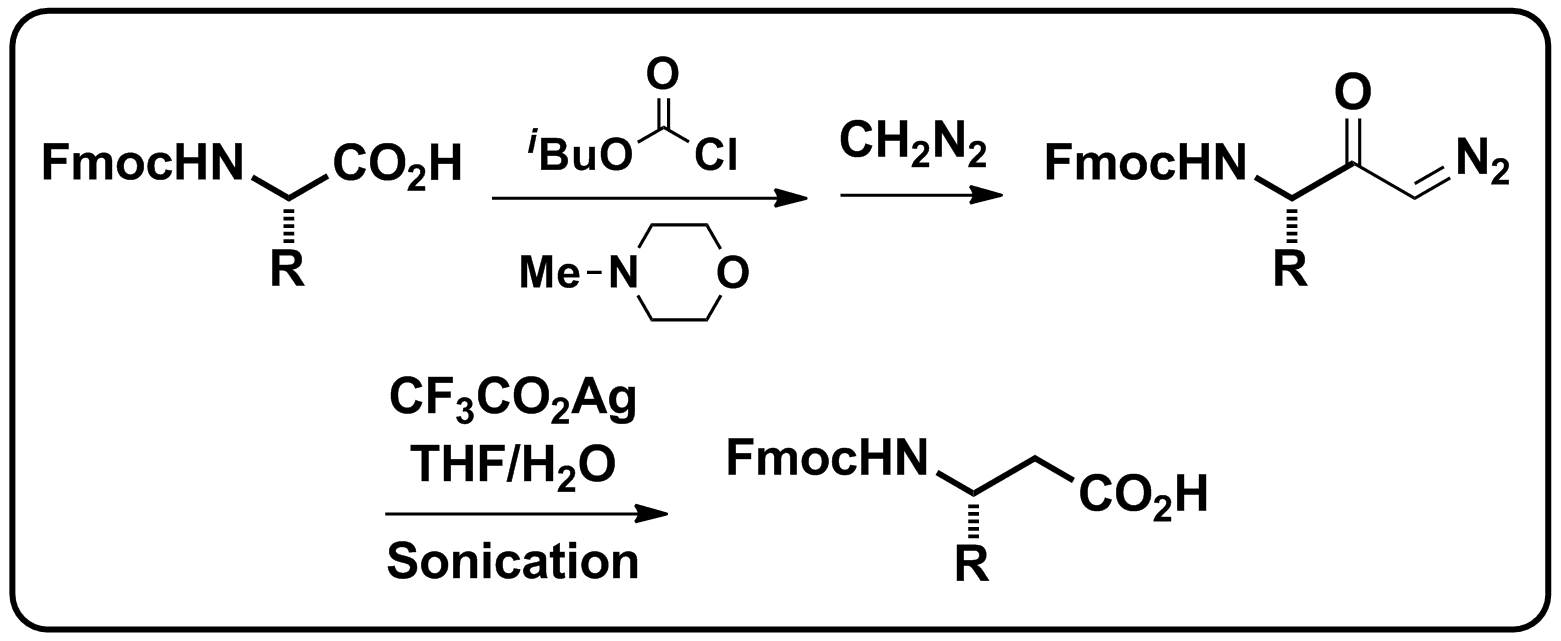
For the past year we have been starting peptidomimetic chemistry up as a new research area in our group. Many chemists believe that peptide chemistry is easy and that peptide chemists aren't "real chemists". However, let me tell you from personal experience that there is absolutely nothing trivial about peptide chemistry. Even short sequences with normal alpha amino acids can be a nightmare to make, troubleshooting is complicated, purification can be a major pain and yields that a small molecule chemist would consider a total fail is generally acceptable in this area of research. Some years ago I was working with a Post Doc that came from Dieter Seebach's lab at ETH. He introduced me to beta amino acids and ever since I have been fascinated by the use of these building blocks in peptidomimetic research. Inspired by the work of Samuel Gellman we are focusing on the use of beta-3 amino acids in combination with alpha amino acids. Consequently, we synthesise beta-3 amino acids to incorporate these in our peptides.

 |
| Silver catalysed Wolff rearragement in a sonicator. Left t = 0 hr; Right t = 2 hr. |

 |
| Diazoinsane clear seal distillation kit purchased from Sigma-Aldrich. |
If you think that playing around with beta-3 amino acids could be fun I can recommend the company Anand Chem based in Slovakia. They produce almost all beta-3 amino acids with the proteinogenic side chains of excellent quality at a highly competitive price. Depending on what they have in stock you may have to wait a couple of weeks for the stuff but it is worth the wait considering the quality and the price. D!


 I wonder what happened to goode olde George and his microscopical reagents. D!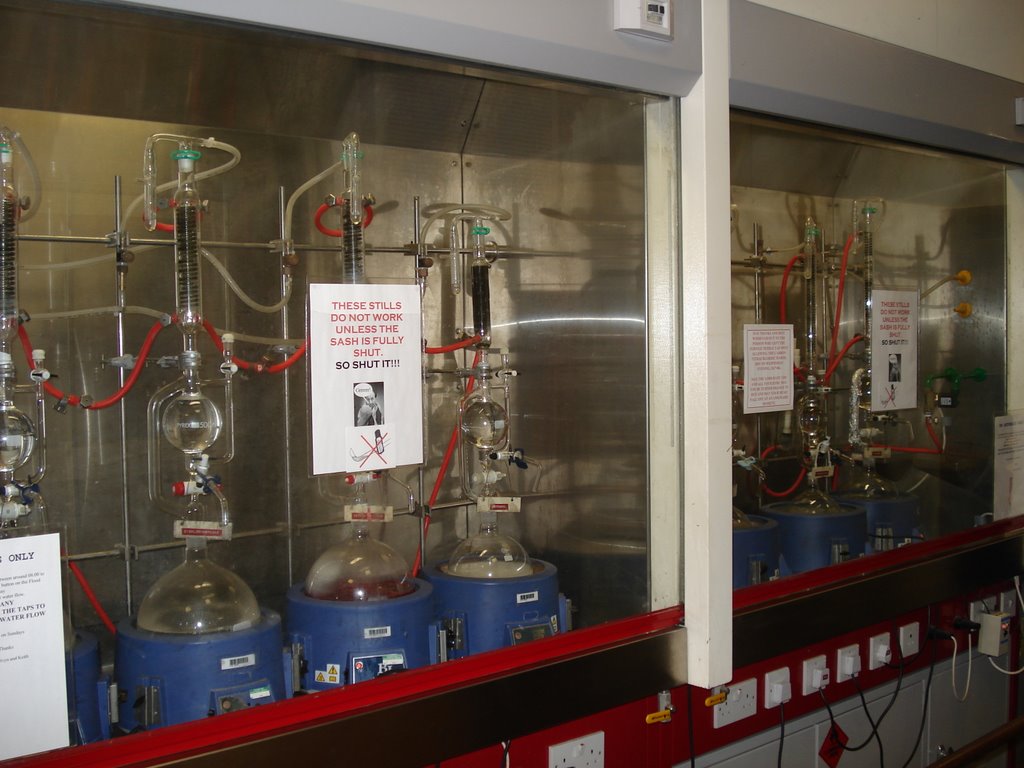

 Now you have to admit that this oxidation uses the coolest reagents ever just judged by their abbreviations.
 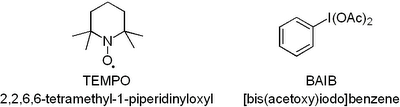 Both TEMPO and
  If you plan to hold on to it for a while it has to go in the freezer otherwise it goes off fast. Have fun, D!

 Nice innit? So how much does it cost to get a kilo of TBDMS-Cl sent to the middle of nowhere? Well the actual product only sets you back 353 AU$ which is pretty damn cheap. However, the freight expenses are a bit out of control and amount to 308 AU$ . So the total price is 661 AU$ meaning it's ~6 times cheaper than to buy it from Aldrich.
 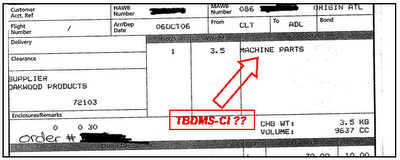 Hmmm very interesting. I guess it makes it a lot easier to get it through customs if you very conveniently forget to mention that it's 1 kilo of a flammable and corrosive chemical substance. Moreover, I noticed that it hasn't been synthesised in the US as I naively assumed.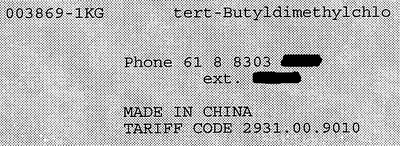


 orcid.org/0000-0003-3926-7047

 Posts
Posts


