
Showing posts with label total synthesis. Show all posts
Showing posts with label total synthesis. Show all posts
Thursday, March 08, 2012
Total Synthsis?


Monday, March 05, 2007
Quinine
 Flipping through C&EN brought my attention to a recent review published in Angewandte Chemie (DOI:10.1002/anie.200601551) about the history of quinine synthesis. If you like (somewhat lengthy) stories about the history of chemistry and natural product synthesis, you might want to print this one out for bedtime reading.
 And don't forget to drink a gin and tonic now and then to keep the malaria away! C!
Monday, December 04, 2006
Adelaide Synthetic Symposium 2006 Part I
They let me out of the lab today. It was time for the annual Synthetic Symposium that was held at Flinders University this year. As usual they fly two big wigs in to present stuff. The remaining talks (6 this time) is given by PhD students. This year the big wigs were Professor Martin Banwell from the Australian National University and Professor Mukund Sibi from North Dakota State University. Both of them gave very interesting talks indeed. Apparently what these guys do is old news. Well It was news to me so here's a brief crackdown on what Banwell had to say. Banwell is a total synthesis man and today he was talking about the synthesis of compounds such as Brunsvigine, Complicatic Acid, 11-O-Debenzoyltashironine etc. The talk was entitled "Chemoenzymatic Methods in Synthesis" and it was the whole chemoenzymatic bit that caught my attention. Basically they are taking simple substituted benzenes and dihydroxylating them. Truly amazing stuff: As Banwell pointed out the example with styrene is unbelievable and the ee's are through the roof! Moreover, the concept isn't limited to monosubstituted systems and more than 250 metabolites of this kind are known by now. So a couple of things immediately spring to mind. What scale can you do this sort of thing on and how do you get the other enantiomer of your product if that is what you are after. Well Banwell was on top of things and addressed these matters during his talk. Firstly, this stuff can be done on big scale. In the case of bromo- and chlorobenzene they obtain 35 grams of stuff per litre of fermentation broth which is pretty damn impressive. If you want the other enantiomer things are a bit trickier. However, Allen et al. have developed a method where the enantioselectivity is switched by introducing an iodine substituent that can be removed after the dihydroxylation:
 A nice and simple solution to a complex problem that was published in Chemical Communications in 1995 (DOI: 10.1039/C39950000117). Anyway, this was just Banwell's introduction. He went on to talk about the total synthesis of a whole range of natural products starting from these metabolites. Most of it was unpublished stuff so I'll be a good boy and not post it all here just yet. Enough for now. I'll post what Professor Sibi had to say some other day. D!
As Banwell pointed out the example with styrene is unbelievable and the ee's are through the roof! Moreover, the concept isn't limited to monosubstituted systems and more than 250 metabolites of this kind are known by now. So a couple of things immediately spring to mind. What scale can you do this sort of thing on and how do you get the other enantiomer of your product if that is what you are after. Well Banwell was on top of things and addressed these matters during his talk. Firstly, this stuff can be done on big scale. In the case of bromo- and chlorobenzene they obtain 35 grams of stuff per litre of fermentation broth which is pretty damn impressive. If you want the other enantiomer things are a bit trickier. However, Allen et al. have developed a method where the enantioselectivity is switched by introducing an iodine substituent that can be removed after the dihydroxylation:A nice and simple solution to a complex problem that was published in Chemical Communications in 1995 (DOI: 10.1039/C39950000117). Anyway, this was just Banwell's introduction. He went on to talk about the total synthesis of a whole range of natural products starting from these metabolites. Most of it was unpublished stuff so I'll be a good boy and not post it all here just yet. Enough for now. I'll post what Professor Sibi had to say some other day. D!Sunday, November 12, 2006
Spiculoic Acid A - sort of
 A couple of days ago one of the guys in the lab alerted my attention to a most interesting paper published in Organic Letters by Baldwin and co-workers from Oxford University. It's concerned with the postulated synthesis of a truncated analogue of Spiculoic Acid A by Mehta and Kundu. But before I get into this latest paper from Baldwin and his mates let's go back and see how it all started.
It all took off in 2005 when Mehta and Kundu from the Indian Institute of Science in Bangalore published the following paper:
-
Toward a Total Synthesis of the Novel Polyketide Natural Product Spiculoic Acid A
Goverdhan Mehta and Uday Kumar Kundupp, Org. Lett., 2005, pp. 5569 - 5572
DOI: 10.1021/ol0521329
-
Now when I read this paper it actually came across as a nice piece of synthetic work. Unusually, these guys blatantly admit that their synthetic strategy towards the natural product failed. So what they do instead is provide a proof of concept by synthesising an analogue of the natural product using some Diels-Alder chemistry. Okay so that's all fine and dandy. At this point I'd like to say that I am very glad that I didn't referee this paper because things are about to get very hairy. Moving swiftly on to 2006 where Baldwin and co-workers publish the total synthesis of the enantiomer of Spiculonic Acid A in Chemical Communications:
-
Biomimetic synthesis of marine sponge metabolite spiculoic acid A and establishment of the absolute configuration of the natural product
James E. D. Kirkham, Victor Lee and Jack E. Baldwin, Chem. Commun., 2006, p. 2863
DOI: 10.1039/b607035c
DOI: 10.1039/b607035c
-
A very nice piece of synthetic work and a well written paper too. These dudes at Oxford really know what they are doing. So at this point I guess that Baldwin and his mates realised that there were some discrepancies between their data and those of Mehta and Kundu. Hence, they decided to sit down and dissect Mehta and Kundu's paper to figure out what was going on. The result of this little exercise was published in Organic Letters recently:
-
Stereochemical Reassignment of Mehta and Kundu's Spiculoic Acid A Analogue
Stereochemical Reassignment of Mehta and Kundu's Spiculoic Acid A Analogue
-
Now this paper is really worth a read. We are talking major bitch slapping here. To me the most unbelievable mistake is the incorrect stereochemical assignment of an epoxide obtained by a Sharpless asymmetric epoxidation. 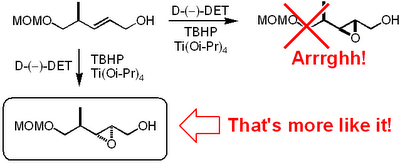 It appears that these Indian dudes haven't been able to use the mnemonic model published by Sharpless to predict the stereochemical outcome. This is what Mehta and Kundu write in their paper regarding the epoxidation:
It appears that these Indian dudes haven't been able to use the mnemonic model published by Sharpless to predict the stereochemical outcome. This is what Mehta and Kundu write in their paper regarding the epoxidation:-
Sharpless epoxidation of allylic alcohol 19 in the presence of the D-tartaric acid diethyl ester was stereoselective (9:1) and afforded the epoxide 20 in a predictable manner with ample precedence.
-
And that's only the beginning. Their NOE interpretations are all over the place and it seems that they can't decide on the final stereochemistry of their Spiculonic Acid A when you compare the structures in the supplementary material with those given in the paper. Here's another brilliant quote from Mehta and Kundu's paper regarding their NOE interpretations (notice the language. One of these guys must have spent some time in the US and bought himself a dictionary):
-
The stereostructure of 9 was delineated on the basis of incisive analyses of its spectral characteristics, particularly the COSY and nOe data.
The stereostructure of 9 was delineated on the basis of incisive analyses of its spectral characteristics, particularly the COSY and nOe data.
-
Anyway, hats off to Baldwin and co-workers for spotting all the mistakes and submitting the paper and to Organic Letters for accepting it. It is quite remarkable to think that these guys from Oxford have managed to publish in Organic Letters without conducting a single experiment. I highly recommend reading these three papers in chronological order. D!
Subscribe to:
Posts (Atom)


 orcid.org/0000-0003-3926-7047

 Posts
Posts

