A while back Chris published a post on a Science paper entitled:
-
-
A very interesting piece of work. However, then one our readers known as aa posted the following comment:
-
"Not sure if this is referenced in the Science paper (should be), but similar work was recently reported by a group at Boehringer Ingelheim in JACS. Check out JACS, 2006, 128, 11350-11351. They use palladium catalysis, and heteroaryl carboxylic acids, but the principle is identical."
-
I finally did something about it and read the JACS paper (DOI:
10.1021/ja063511f). Now first of all the German dudes who published their stuff in Science would have been hard pressed to cite the Boehringer Ingelheim group since their manuscript was submitted a month before the Boehringer people got round to it. The JACS paper is however very interesting. In fact, I find it even more exciting than the Science paper because these guys are making some pretty nice
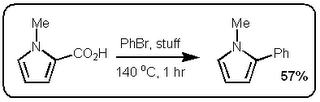
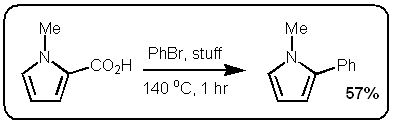
heteroaromatic systems that would make any pharma medchem person wet his pants. Moreover, they are doing it with excellent selectivity and in good yield. Most of the stuff in the paper is done under microwave conditions but they do one old school thermal example that works okay (See Scheme above).
So at first glance these two papers seem very similar. However the postulated mechanisms are quite different. Firstly, the stuff in the Science paper starts of with a decarboxylation / copper insertion followed by a transmetallation and so forth. So in other words all the action is happening where the new bond is being made, like this:

However, the stuff in the JACS paper is different. Firstly, it only works if the carboxylic acid is adjacent to the heteroatom. Secondly, palladium adds adjacent to the carboxylic acid
via an electrophilic palladation followed by palladium migration and concomitant decarboxylation. Finally the generated palladium species undergoes reductive elimination to form the desired product like this:

In other words quite a different mechanism that doesn't involve a transmetallation step.
Anyway, thanks to
aa for the tip. This has been most educational. D!


 The Cambridge NMR service
  D!
D! A very important detail is that the template is a simple, achiral unit. The sole purpose of the template is to coordinate the Lewis acid well, exert rotamer control and as a consequence give good facial selective for the incoming nucleophile. Now as I mentioned before this principal works very well for many reactions. The Lewis acid is used in sub-stoichiometric quantities (generally 10-20 mol%). The radical stuff that I outlined above is okay cool but I personally like his stuff on pericyclic reactions better. Back in 2001 he published a very interesting paper in JACS (DOI:

 This time there's also regioselectivity issues. However, they solve this and all other associated problems elegantly producing the desired dihydropyrazoles in excellent yields and ee's.
 As Banwell pointed out the example with styrene is unbelievable and the ee's are through the roof! Moreover, the concept isn't limited to monosubstituted systems and more than 250 metabolites of this kind are known by now. So a couple of things immediately spring to mind. What scale can you do this sort of thing on and how do you get the other enantiomer of your product if that is what you are after. Well Banwell was on top of things and addressed these matters during his talk. Firstly, this stuff can be done on big scale. In the case of bromo- and chlorobenzene they obtain 35 grams of stuff per litre of fermentation broth which is pretty damn impressive. If you want the other enantiomer things are a bit trickier. However, Allen et al. have developed a method where the enantioselectivity is switched by introducing an iodine substituent that can be removed after the dihydroxylation:
 A nice and simple solution to a complex problem that was published in Chemical Communications in 1995 (DOI:
 However, the stuff in the JACS paper is different. Firstly, it only works if the carboxylic acid is adjacent to the heteroatom. Secondly, palladium adds adjacent to the carboxylic acid via an electrophilic palladation followed by palladium migration and concomitant decarboxylation. Finally the generated palladium species undergoes reductive elimination to form the desired product like this:
  In other words quite a different mechanism that doesn't involve a transmetallation step.



 orcid.org/0000-0003-3926-7047

 Posts
Posts